
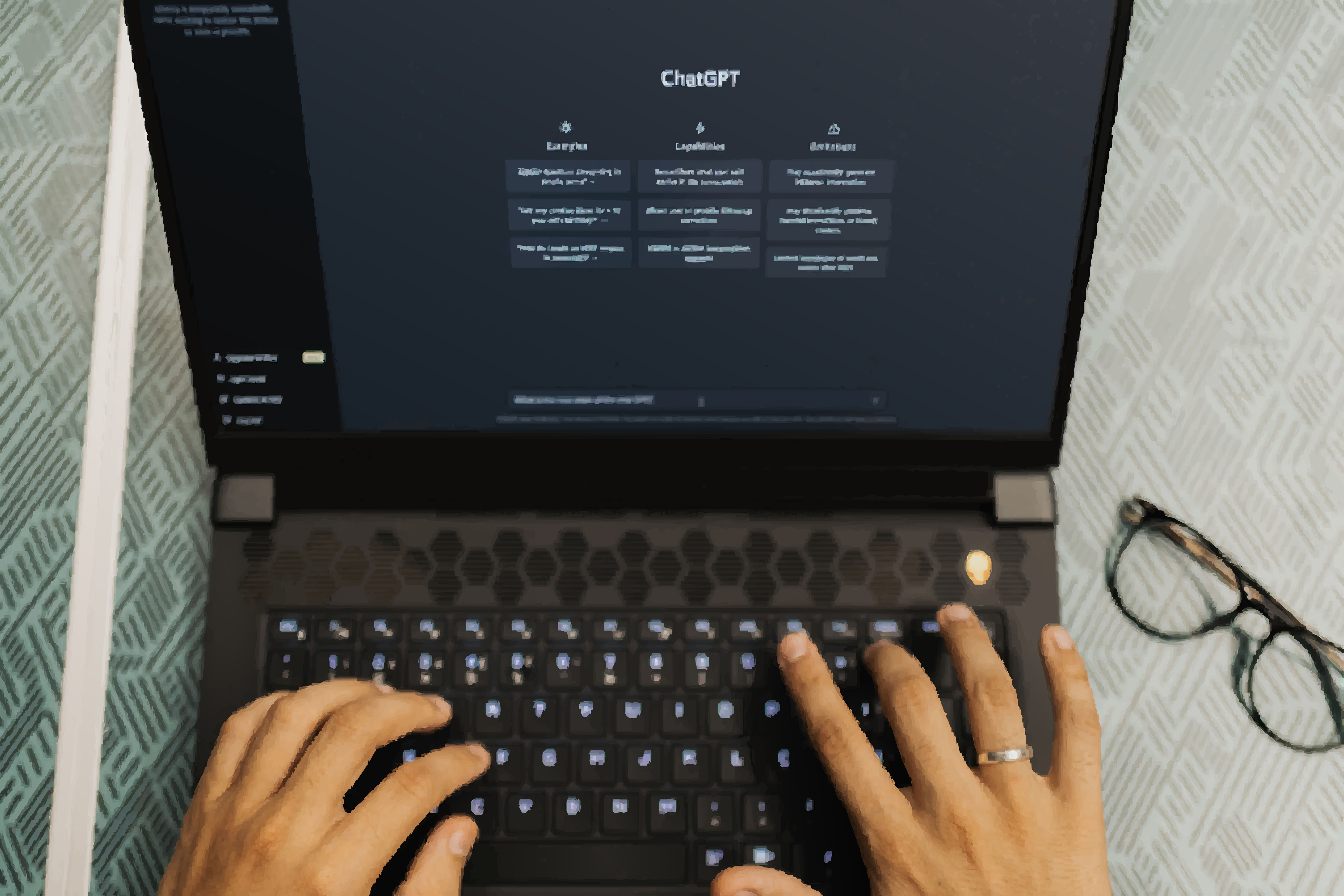
Visible in ChatGPT and Google AI Overviews
Somebody typed a question into ChatGPT this morning about a service your business offers. An answer came back instantly, confident and specific, naming three companies worth considering. Yours wasn’t one of them. You’re not worse than the competitors mentioned. No one told you that you had already entered this competition, whether you signed up or not. The good news is that you can still get visible in ChatGPT and Google AI Overviews if you start building the right signals now.
That’s the uncomfortable reality of search in 2026. ChatGPT now handles about 910 million weekly active users. Google’s AI Overviews reach roughly 2 billion people each month across more than 200 countries. Those aren’t niche numbers anymore. They signal a real change in how people find businesses. Most business owners haven’t grasped what this means for them.
This article explains what’s changed. It explains why that matters beyond typical SEO advice. It shows what works for appearing when an AI system asks a question instead of typing into a search bar.
Key Takeaways
There’s a common assumption that business visibility in ChatGPT and Google AI overviews is a game only large, well-funded brands can play. The data doesn’t support that. AI citation depends heavily on clarity, structure, and demonstrated first-hand expertise. It relies less on raw domain authority or advertising budget. Smaller, well-organized businesses with genuinely useful content can compete for citations, unlike traditional SEO.
The businesses at the greatest disadvantage right now aren’t small ones. They’re the ones doing nothing at all while this shift settles into place.
- Visible in ChatGPT and Google AI Overviews
- A Practical Framework to Be Visible in ChatGPT and Google AI Overviews
- Frequently Asked Questions
Search Isn’t Broken. It’s Just Quieter Now.
Here’s a number that should reframe how you think about your website traffic: 68% of U.S. Google searches in 2026 now end without a single click to any website. That figure has climbed from about 50% in 2019. The trend predates AI entirely. It started with featured snippets and knowledge panels and then accelerated once generative AI entered the picture.
The acceleration is the part worth paying attention to. When an AI Overview appears on a search results page, the zero-click rate jumps to 83%. This finding is based on research compiled from BrightEdge, Semrush, and Similarweb data. In short, eight of ten people see an AI-generated summary. They get the answer there and never visit a website. On mobile, where most searches now occur, that number climbs further. Mobile zero-click rates sit around 77%, compared to 46.5% on desktop.
Pew Research found something more specific. Users click through on just 8% of searches when an AI Overview is present, vs 15% when it isn’t. That’s roughly half the click-through rate, disappearing almost overnight for millions of searches every single day.
None of this means people have stopped looking for businesses like yours. It means the moment where they discover you has moved. It used to happen on a results page, where your blue link competed with nine others. Now it often happens inside a single AI-generated paragraph. There is no scrolling, no second page, and no ranking position three or four to fall back on. That paragraph mentions your business, or your business effectively doesn’t exist for that search.
What “AI Visibility” Actually Means
AI visibility has a name in the industry now. People sometimes call it Answer Engine Optimization (AEO) or Generative Engine Optimization (GEO). It refers to how often, and how prominently, your brand shows up inside the answers generated by ChatGPT, Google’s AI Overviews, Perplexity, Gemini, and similar tools — as opposed to traditional SEO, which is about ranking a link on a results page.
The gap between the two is bigger than most businesses realize. One recent industry assessment found that the average B2B company scores just 28 out of 100 when evaluated for AI visibility across ChatGPT, Perplexity, Gemini, and Claude. At that score, a business is either completely absent or actively misrepresented during what’s arguably the most influential stage of a customer’s decision-making process — the moment they’re asking a direct question and expecting a direct, trustworthy answer.
The good news buried inside that bad number: AI visibility is measurable, and it’s genuinely improvable with the right approach. Unlike traditional SEO, where thousands of established sites have a decade-long head start, this space is still forming. That’s an opportunity, not just a warning.
Why AI Overviews and ChatGPT Choose the Sources They Choose
Generative engines don’t rank pages the way Google’s classic algorithm does. They synthesize an answer by pulling from multiple sources. In real time, they decide which should be cited. Understanding what influences that decision is the actual foundation of getting visible.
Clarity and Structure Beat Cleverness
AI systems extract information more easily from content that answers a question directly and early. Content that builds up to an answer with a long narrative introduction is harder to parse. A paragraph that opens with a clear, complete answer to a specific question is far more citable than one that meanders toward it.
Schema Markup Signals Machine-Readability
Structured data — the behind-the-scenes code that tells search engines exactly what a piece of content is (a service, a review, a set of business hours, an FAQ) — has become one of the more reliable levers available. AI-generated summaries are likely to include your content when you add structured data, since it clarifies what your content represents.
Consistency Across the Web Builds “Entity Authority”
AI systems increasingly evaluate businesses the way a skeptical human might: by cross-referencing multiple sources to see whether the story adds up. Ensure your business name, address, phone number, and service details match exactly across your website, your Google Business Profile, and the directories where you’re listed. Inconsistent details — a different phone number here, an outdated address there — quietly erode the confidence these systems place in your business as a real, verifiable entity.
Fresh, First-Person Experience Signals Trust
Experts increasingly regard first-person experience as a key differentiator in 2026, with phrases like ‘in our experience’ or ‘when we handled this for a client’ signaling a human perspective an AI model can’t fabricate on its own. Original photography, real case details, and named, credentialed authors all reinforce this. Generic, unattributed content is easier for these systems to treat as replaceable filler rather than a trustworthy source.
Platform Fragmentation Is Real
Here’s a detail most advice skips entirely: ChatGPT cites unique URLs roughly 37% of the time for identical prompts, according to citation-tracking research, and the sources different AI platforms pull from vary significantly. Wikipedia’s citation dominance, for instance, is largely unique to ChatGPT and doesn’t carry over to Perplexity or Google’s AI Overviews in the same way. What earns a citation on one platform won’t automatically transfer to another — which means a single, generic “AI SEO strategy” isn’t really a strategy at all. Platform-specific thinking matters.
The Access Problem: Are AI Crawlers Even Allowed on Your Site?
This is a step many businesses skip entirely, and it’s a simple, binary gate before anything else matters: if your website blocks AI crawlers like GPTBot, you cannot be cited by that system, no matter how good your content is.
Here’s a statistic that reframes the competitive picture: around 82% of top news sites currently block GPT Bot from accessing their content. That sounds like a reasonable defensive move for large publishers protecting their content from being reused without compensation. But for a small or mid-sized business trying to build visibility, it’s the opposite of useful. Brands that allow AI crawlers face measurably less competition for citations, simply because so many major, high-authority sites have opted out. Unless there’s a specific, deliberate reason to protect your content from AI training, allowing these crawlers is close to a prerequisite for being visible in ChatGPT and Google AI Overviews.
What This Means for Anyone Running a Website Right Now
A few concrete shifts follow directly from everything above.
- Traffic and citation are no longer the same goal. For a growing share of informational content — explainer posts, “what is” and “how to” articles — the realistic outcome is a citation inside an AI answer, not a click to your website. Measuring that content purely by sessions and pageviews misses what it’s actually accomplishing. Brand recall and citation frequency are becoming the more honest success metrics for this category of content.
- The traffic that does arrive tends to be higher quality. Even as overall click volume drops, the clicks that survive an AI overview convert roughly 23% better than average, because the person clicking has already read a summary and is actively seeking deeper information — not casually browsing. Fewer visitors, but more of them arrive with real intent.
- Brand search becomes a meaningful proxy metric. If your content is genuinely being cited and seen inside AI answers, you should expect to see a gradual rise in people searching for your business by name afterward. Flat or declining branded search, even while general visibility grows, usually signals that your content is technically present but not compelling enough to prompt a follow-up search — a useful diagnostic most businesses never think to track.
- This is still early enough to matter. Google’s AI Mode — its fully generative, conversation-first search interface — had already surpassed 1 billion monthly users by Google’s own I/O 2026 announcement, with query volume more than doubling every quarter. The businesses building AI visibility now, while most competitors are still treating this as a future problem, are the ones positioned to own that territory before it gets crowded.
A Practical Framework to Be Visible in ChatGPT and Google AI Overviews
- Step 1: Find Out Where You Actually Stand
Before optimizing anything, run a simple audit. Ask ChatGPT, Perplexity, and Google’s AI Overview 10–15 realistic questions your ideal customer might ask — category questions (“what are the best [service] providers in [location]”), comparison questions, and specific-need questions. Note whether your business appears at all, and if it does, whether the details mentioned are accurate.
- Step 2: Fix Structural Basics First
Ensure your site allows AI crawlers, implement schema markup for your services, FAQs, and reviews, and confirm your NAP (Name, Address, Phone) information is identical everywhere it appears online — website, Google Business Profile, and any directory listing.
- Step 3: Write to Be Extracted, Not Just Read
Restructure key pages so the direct answer to a likely question appears within the first sentence or two of a section, followed by supporting detail. FAQ sections are consistently among the most-cited content formats in AI Overviews, precisely because they’re already structured as question-and-answer pairs — exactly the format these systems are built to extract from.
- Step 4: Build Genuine Topical Depth
AI systems favor sources that demonstrate real depth across a subject rather than a single strong article surrounded by thin, unrelated content. Interlinked clusters of related posts. It values several genuinely useful articles covering different angles of the same core topic.
- Step 5: Earn Mentions on Sites AI Systems Already Trust
Since AI platforms pull disproportionately from sources they already cite frequently, getting mentioned in existing, well-cited industry content, guest posts, or expert roundups carries outsized value compared to traditional link-building, where a raw backlink count used to be the primary goal.
- Step 6: Refresh Regularly
AI-generated summaries lean toward fresh, current information. Content left untouched for a year or more steadily loses ground to newer material covering the same ground, even if the older content was originally stronger. A practical refresh cycle helps maintain citation eligibility over time.
- Step 7: Monitor, Don’t Guess
AI visibility is trackable, even without expensive tools, through the manual spot-check method described in Step 1, repeated periodically. Watching how your presence shifts over 60 to 90 days gives a realistic read on whether the changes made are actually working. Most brands see initial movement within that window, with more meaningful share-of-voice gains typically appearing somewhat later.
Why Small Businesses Need to Be Visible in ChatGPT and Google AI Overviews
There’s a common assumption that being visible in ChatGPT and Google AI Overviews is a game only large, well-funded brands can play. The data doesn’t support that. Because AI citation depends heavily on clarity, structure, and demonstrated first-hand expertise rather than raw domain authority or advertising budget, a smaller, well-organized business with genuinely useful, specific content can compete for citations in ways that were far harder in traditional SEO, where a decade of accumulated backlinks often decided the outcome before the competition even began.
The businesses at the greatest disadvantage right now aren’t small ones — they’re the ones doing nothing at all while this shift settles into place.
Where The DigiFlow Fits into This
At The DigiFlow, this is exactly the kind of shift we build strategy around before it becomes common knowledge — not after. Structuring content for AI extraction, cleaning up entity consistency across the web, and building the kind of genuinely useful, well-organized content that both traditional search and AI systems favor isn’t a separate service bolted onto SEO. It’s what SEO is quietly becoming.
Want to know where your business actually stands in ChatGPT and Google’s AI Overviews right now? [Talk to TheDigiFlow →]
Frequently Asked Questions
Sources
- Frase — What Is AI Visibility? Complete Guide (2026)
- The Pedowitz Group — How to Improve Your Brand’s AI Visibility
- Omnia — How to Improve Brand Visibility in ChatGPT in 2026
- Explore Digital — AI Search Optimization: Get Your Brand Cited
- Omnibound — AI SEO Statistics 2026
- Omnibound — Zero-Click Search Statistics 2026
- Search Engine Land — Google Zero-Click Searches Reach 68% in Early 2026
- Similarweb — Zero-Click Marketing: What the 2026 Data Means
- Strategyc — Zero Click Search Statistics 2026
Statistics compiled from SparkToro, BrightEdge, Semrush, Pew Research, and Google’s own I/O 2026 announcement.